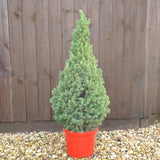
Yes, a Christmas tree in a pot can go outside after Christmas and live for years. Whether yours does comes down to how it was grown, and what you do with it during the fortnight it spends in your living room.
Pot grown or potted, and why it matters
Both get sold as a tree in a pot. They are not the same thing, and the difference decides whether yours has a future.
Pot grown trees were raised in the pot from the start. The roots fill it, the tree has never been cut off from them, and it carries on growing afterwards. These are the ones worth buying if you want a tree you keep.
Potted trees were grown in a field, dug up, and dropped into a pot with some compost. Cheaper, and they look identical in the shop. The problem is underneath: most of the root system stayed in the field. In a warm room the needles draw more water than those few remaining roots can supply, and the tree dies slowly over Christmas whether you water it or not.
If you cannot tell which you have, tip it gently and look. A pot grown tree holds its rootball together when you lift it. A potted one slides about in loose compost.

The fortnight indoors is the dangerous bit
A living tree in a centrally heated room is a conifer in a drought.
- Keep it in no longer than 12 days. Two weeks is the outside limit. The longer it sits in the warm, the harder the move back out.
- Pick the coolest spot you can live with. Away from radiators, wood burners and sunny windows.
- Check the compost every day. Push a finger in. If the top couple of centimetres feel dry, water it. A tree indoors can take a litre a day in a warm room.
- Do not let it stand in water. Damp is what it wants, waterlogged will rot the roots.
- Put a saucer or a cache pot under it. Nursery pots drain straight onto the carpet.

Join the P2G Garden Club and we’ll email you each week’s deal, plus the month’s garden jobs. Free to join, unsubscribe any time.
Join the Garden ClubPotting one up
Most living trees arrive in a plain nursery pot. You can decorate round it, or pot it properly, which is better for the tree and looks a good deal nicer.
Go up one size only, 5cm or so wider than the pot it came in. A tree swimming in a huge pot of wet compost is worse off than a snug one. Make sure there are drainage holes, use a loam based compost rather than a light multipurpose, and firm it in without burying the trunk any deeper than it already sits.
Heavy is good here. A tall tree in a light plastic pot goes over the first time the cat investigates, so a decent weighty pot earns its place, and then does the rest of the year on the doorstep.
Moving it outside after Christmas
This is where most living trees are lost, and it takes about a week of patience to get right.
Your tree has spent a fortnight at 20 degrees. Carrying it straight out to a January frost shocks it badly. Give it a halfway house first: an unheated porch, a garage, a shed with some light, anywhere cold but frost free, for 5 to 7 days. Then out it goes.
Outside, stand it somewhere sheltered from the worst of the wind. Keep watering through the winter, which sounds mad in January, but a pot sitting under the eaves gets no rain at all and dries out quietly.
You can plant it in the ground instead if you have the room. Once a Nordmann is in the soil it will reach well over 10 metres, so only do that if you are happy for it to stay there.
Getting it through to next year
A pot grown tree is a garden plant for 50 weeks of the year and a decoration for two. Treat it as the former.
Give it a slow release feed in spring and again in early autumn. Water it in dry spells, properly, the way you would any established pot. Pot it on a size every second or third year, in spring.
Expect 15 to 20cm of growth a year in a container, so a 1 metre tree is still a sensible house guest in four or five Christmases. Bring it back in as late as you can bear in December.
What about a cut tree
A cut tree has no roots and cannot be planted, whatever it looks like at the base. It does one job for a few weeks and then goes for chipping or to the council's collection.
Get the most out of it by sawing a couple of centimetres off the bottom of the trunk before it goes in the stand, the same way you would cut flowers, then keeping the stand topped up with water every single day. A cut tree drinks more than people expect in the first week. Keep it off the radiator and out of direct sun and it will hold its needles far longer.
Are Christmas trees poisonous to dogs and cats
Firs and spruces are not considered toxic to cats or dogs. The nuisances are the needles, which get stuck in paws and will irritate a stomach if enough are eaten, and the water in a cut tree's stand, which is worth covering if your dog drinks from anything it finds.
Which variety to look for
Nordmann fir (Abies nordmanniana) is the one we grow and the one most people picture: tiered, soft to handle, aromatic, and famously reluctant to drop its needles.
For a smaller living tree, the dwarf Alberta spruce, Picea glauca Conica, is hard to beat. It comes as a neat cone about the size of a table tree, lives happily in a pot for years, and spends the other 50 weeks as a proper garden conifer.